
Bamberg County Arrest Warrants Explained
An arrest warrant begins with a sworn request laying out facts that support probable cause. South Carolina Code Section 22-5-110 gives a magistrate the authority to issue one on an officer's request. The judge reviews what is presented. The form and the return then identify the court, the alleged offense, the agency, and the service action taken. A Bamberg County warrant can start in Magistrate or municipal court, or in a serious case move up through Circuit Court's General Sessions division. Court, clerk, and serving officer each hold a different piece of the file.
Bamberg County Arrest Warrant Affidavit
South Carolina Advisory Opinion 11-2025 lays out the normal-hours routine. An officer brings a probable-cause affidavit to the city or Magistrate clerk, and for a Bamberg County arrest file the statement carries identifying details, a statute or CDR code, and the supporting facts. The clerk enters the matter into the court system, the officer is sworn, and a judge decides whether probable cause supports the order. Do not expect the affidavit to surface as a public online result. A sealed or active investigative record may carry access limits, so ask the issuing court directly what part of the case file is open.
Inside a Bamberg County Arrest Warrant
The state form family for arrest warrants carries a caption, an identifying block, the offense, a probable-cause narrative, the issuing judge, and a service return. Bamberg publishes no sample of its own and no numbering format. Treat the state family as a schema only, not a promise that the Court Roster Search displays every field for Bamberg County.
| Case or warrant number | Use the number printed on a court paper; no local prefix format was found. |
|---|---|
| Offense | May include the statute or South Carolina CDR code. |
| Issuing court | Shows which judge or court controls the file. |
| Affidavit | Sworn facts support the probable-cause request; access may be restricted. |
| Officer return | Records service, attempt, officer, and date information. |
| Bond | Set in a separate bond proceeding; confirm its terms with the court. |
Bamberg County After-Hours Arrest Warrants
The 2025 advisory opinion also sketches the after-hours path. There, an on-call judge may enter or generate the process, though the judge cannot repair a defective affidavit and may simply decline to sign. For a Bamberg County file, that is statewide process guidance and nothing more. It is not a portal, not a schedule, and not a way to search a case. For a particular file, ask the issuing clerk or agency which court reviewed it and where service status is recorded. The Bamberg County Sheriff's Office website shows no public warrant roster.
Serving Arrest Warrants in Bamberg County
Within their duties, the Bamberg County Sheriff's Office and participating police agencies serve warrants. The Bamberg County communications page lists the supported agencies: the Sheriff, Bamberg Police, Denmark Police, Govan Police, Ehrhardt Police, and Highway Patrol. Dispatch routes calls. It is not a warrant confirmation line. After service, the officer's return goes back through the court process, so ask the issuing clerk whether service was recorded, whether bond is set, and which court handles the next appearance. The detention center lists a custody contact but publishes no public walk-in or bond-window rules.
Bamberg County Arrest Warrant Rule 3 Transmittal
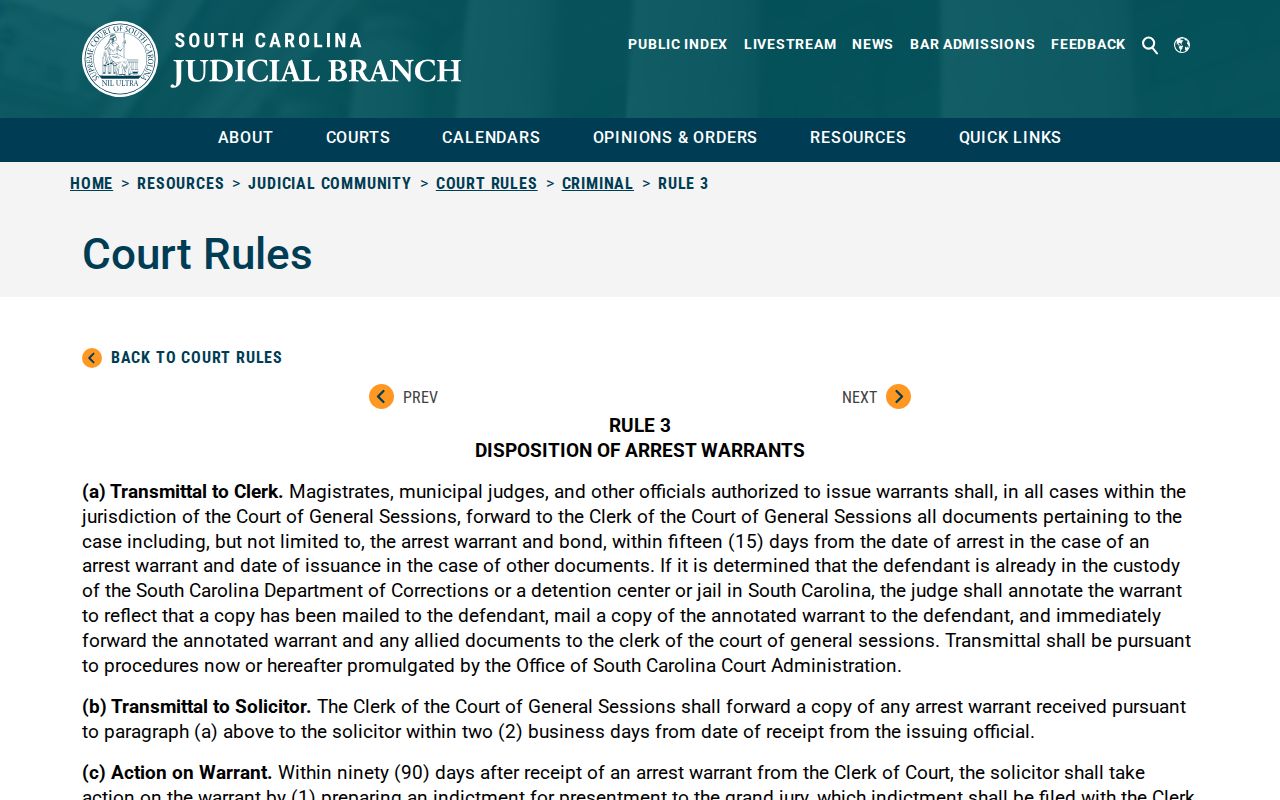
When a Bamberg County summary-court arrest warrant enters the General Sessions process, South Carolina Criminal Rule 3 governs the transmittal steps among the issuing court, the Clerk, and the Solicitor. The Bamberg County Clerk receives General Sessions criminal warrants and passes them to the Circuit 2 Solicitor. That hand-off explains why the current file may sit in a different office from the one that first issued it. The rule sets the official warrant-transmittal process. Read South Carolina Criminal Rule 3.
If an office sends you elsewhere, get the receiving court and case number in Bamberg County before you make the next request.
Comparing Arrest, Summons, and Bench Warrants
A summons orders a person to appear without taking them into custody at once. An arrest warrant authorizes custody based on probable cause. A bench warrant usually follows a missed appearance or a court directive, and a later failure to appear can open a separate court process in Bamberg County.
| Process | What starts it | First question |
|---|---|---|
| Arrest warrant | Sworn probable-cause request | Which court issued and serves it? |
| Summons | Order to appear on a date | What date and court are listed? |
| Bench warrant | Missed appearance or court duty | Can the court reset, recall, or set bond? |
Bamberg County Sheriff Service Records
The Bamberg County Sheriff's Office offers no public arrest-warrant search box, no status list, and no warrant-specific phone line. Its public contacts simply route records questions. Deputies may serve a warrant or help you find the right records office, but the issuing court decides recall and bond. For Bamberg County General Sessions, call the Clerk's direct line at (803) 245-3025. For a Bamberg County Magistrate matter, the state directory lists (803) 245-3016. For detention questions, call the Bamberg County Detention Center at (803) 245-3020. Verify the hearing or surrender location before you travel.
Bamberg County Bond Is a Separate Record
In a Bamberg County case, bond paperwork stands apart from the arrest warrant. The forms record the release type and its conditions, and South Carolina forms include recognizance, cash, percentage, and surety options. Bamberg County has posted no universal bond amount, no online bond portal, and no warrant-processing fee. The court must confirm the amount and who may accept payment. A paid fee or posted bond does not close the charge, so keep the bond paper and ask the court for the next setting and any written release condition.
If There's an Arrest Warrant for You
Before you act, confirm the issuing court, the warrant's status, bond, and appearance instructions. A lawyer can ask the Bamberg County court whether a motion, a scheduled appearance, or voluntary surrender is on the table. If the matter has moved to General Sessions, the Clerk routes record questions while the Solicitor and court handle the case process.
Get case-specific advice: ask counsel about surrender, bond, and any motion to recall or quash. Do not rely on an online absence or an unrelated history result.
Once a Bamberg County warrant is served or recalled, get the new court date in writing. The case itself can continue after the warrant is resolved.